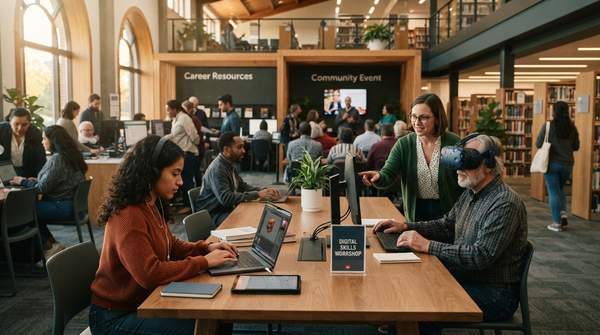
Ask what a public library offers and most people will say books. The better answer is that it offers a civic living room. Modern public libraries lend computers and career coaching, host book clubs and ski-gear swaps, run digital literacy workshops, and serve as trusted ground where residents meet elected officials. A 2024 town hall convened by the Urban Libraries Council described libraries as a "trusted public common for social innovation and civic engagement" whose role "spans far beyond books." Here is how to recognize the full range of what your library does—and what to look for when you walk in.
Beyond Books: The Evolving Role of Public Libraries
For decades, the library's brand was built on its shelves. That framing is now outdated. Librarian Tara Franzetti, speaking at a TEDxYouth event in 2017, described her duties as busier than ever because public libraries themselves are more vibrant than ever—and noted that young people are the most common users of public libraries, more than any other age group.
Institutional reporting backs this up. A California State Library overview puts it bluntly: "Books are just the tip of the library iceberg." Public libraries, it explains, help communities "learn, explore, connect, and have fun," with programs spanning arts and culture, health and wellness, civics, science, history, and technology. Career centers and business resources support job seekers, entrepreneurs, and the local economy, while online services—databases, streamed video, chat-based reference help, and homework support—extend the library's reach "all day, every day."
The federal government tracks this evolution directly. The Institute of Museum and Library Services, which surveys the nation's roughly 9,000 public libraries and their 16,500 branches and bookmobiles, has documented libraries "responding to changing 21st century needs," including growth in children's and young adult programming and a significant expansion of downloadable audio, video, and e-books.